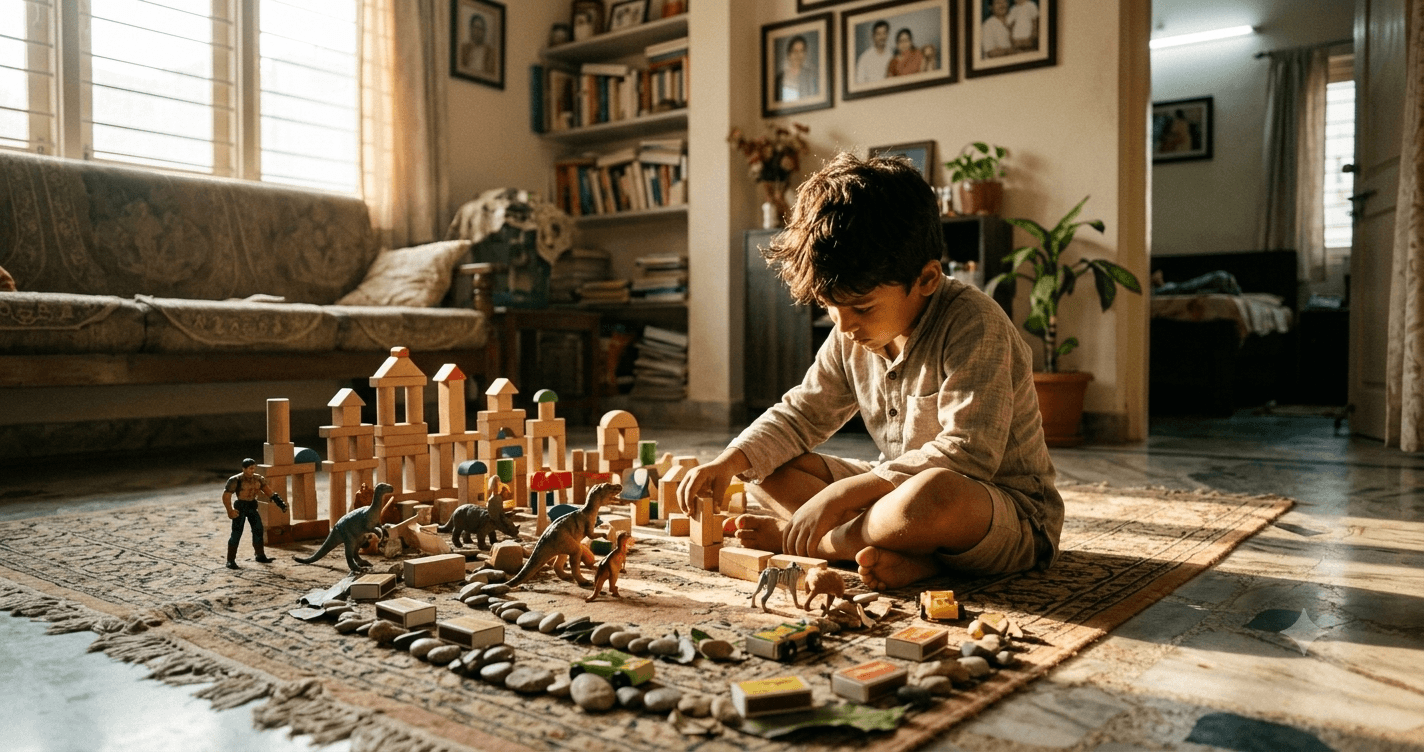
There's a particular kind of moment every parent has witnessed without quite registering its importance. Your child, alone, deeply absorbed — narrating a story to a row of toys, building and rebuilding a structure, lost in a game with rules only they understand. No adult directing it. No goal anyone set. Just a child, freely playing.
It looks like nothing. It is, in fact, one of the richest sources of insight into who your child is and what they may become.
Why free play is more honest than anything organised
Most of what we watch our children do is shaped by us. The class we chose, the homework we assigned, the activity we suggested. In all of it, the child is partly performing — meeting an expectation, pleasing an adult, following a structure.
Free play is different. Researchers call it exactly that — "free play" — and they take it seriously. Scientific American, drawing on decades of research, describes free play as critical for becoming socially adept, coping with stress, and building cognitive skills like problem-solving. The psychiatrist Stuart Brown, founder of the National Institute for Play, interviewed thousands of people about their childhoods and concluded that a lack of free play can keep children from growing into well-adjusted adults.
But for our purposes here, the key quality of free play is this: because no adult sets the goal, it's the truest signal of what a child actually gravitates toward. Strip away every expectation, and what your child chooses to do is the closest thing you have to a direct readout of their natural wiring.
What play is actually building
It's worth knowing that free play isn't just revealing strengths — it's building them. The American Academy of Pediatrics states that play allows children to develop creativity, imagination, dexterity, and physical, cognitive, and emotional strength, and that it's essential to healthy brain development.
In particular, unstructured play develops something researchers call self-directed executive function — the ability to set a goal, plan toward it, and regulate oneself along the way. A child inventing a game makes up rules, enforces them, adapts when they don't work, and manages their own frustration when a tower falls. That's not "just playing." That's a child practising the exact mental machinery of a capable adult.
So when you watch free play, you're watching strengths being revealed and forged at the same time.
How to read the signals
Once you know to look, free play becomes wonderfully informative. Watch for what kind of play your child returns to again and again, and what it points toward:
- Builds, designs, arranges, takes apart → spatial and analytical wiring. The mind drawn to how things fit and work.
- Tells stories, role-plays, invents characters and worlds → creative and linguistic strength. The imaginative, narrative mind.
- Organises games with others, assigns roles, mediates, leads → social intelligence. The child whose medium is people.
- Can't play sitting down — climbs, races, performs physically → bodily-kinesthetic strength. The child who thinks through movement.
- Hums, drums, sets play to rhythm or song → musical wiring.
- Plays with insects, plants, collects and classifies natural things → naturalistic curiosity.
The reliable signal, as always, is the pattern — not one afternoon, but what repeats, what they choose freely, and what leaves them more energised than when they began.
How to protect (and observe) free play
Here's the uncomfortable modern truth: free play is being squeezed out. Between school, homework, organised classes, and screens, the unstructured, child-led time that reveals so much has less and less room. Protecting it is both a gift to your child's development and a gift to your own understanding of them.
A few simple things help:
- Leave genuinely unstructured time in the week — no class, no screen, no agenda. Boredom is often the doorway to the most revealing play.
- Provide open-ended materials — blocks, art supplies, objects that can become anything — rather than toys that do only one thing.
- Resist directing. The moment you suggest, correct, or set a goal, it stops being free play and stops being an honest signal. Hang back and watch.
- Keep light notes. What did they choose? How long did they stay? What did they return to? Patterns emerge faster than you'd expect.
From watching play to understanding your child
The wonderful thing is that this costs nothing and you can begin today, simply by stepping back and paying attention during the play that's already happening in your home.
If you'd like a framework to make sense of what you're observing — to turn "she always builds things" or "he never stops moving" into a clearer map of your child's talent zones — that's exactly what My Child's Talent Finder is designed to do. You bring the observations from your child's everyday play; it helps you decode them into clear talent signals. For a quicker structured read across your child's strengths, the Talent Discovery assessment takes about 30 minutes for ₹99.
The next time your child disappears into a game of their own making, resist the urge to tidy it away or fill the time with something "productive." Sit back instead. They're showing you, in the most honest way a child can, exactly who they are.
Sources: Unstructured Play Is Critical to Child Development, Scientific American; The Importance of Play, American Academy of Pediatrics.