Every Indian parent knows the ritual. Results come out. We scan for the percentage. We feel relief or worry. And in that single number, we believe we've learned something true about our child's mind.
We've learned something — but far less than we think.
There's a framework, now decades old and used in classrooms around the world, that reframes the whole question of what it means for a child to be "smart." For Indian parents raising children inside a marks-driven system, it might be one of the most freeing ideas you'll encounter.
The idea that broke the single-score myth
In 1983, a Harvard developmental psychologist named Howard Gardner published a book called Frames of Mind. In it, he challenged something almost everyone took for granted: that intelligence is one thing, measurable by one test, expressible as one number.
Gardner's theory of multiple intelligences argued instead that human intelligence comes in at least eight distinct forms. He defined intelligence not as a test score but as the potential to process information in ways that solve problems or create things of value — and he pointed out that this potential shows up in radically different domains from one person to the next.
The eight intelligences, in plain terms
Here's Gardner's list, translated out of academic language:
- Linguistic — smart with words. Reading, writing, storytelling, languages.
- Logical-mathematical — smart with logic and numbers. Reasoning, patterns, problem-solving.
- Spatial — smart with space and images. Visualising, designing, building, navigating.
- Musical — smart with sound. Rhythm, melody, tone.
- Bodily-kinesthetic — smart with the body. Movement, coordination, hands-on skill.
- Interpersonal — smart with people. Reading others, leading, empathising.
- Intrapersonal — smart with oneself. Self-awareness, reflection, knowing one's own mind.
- Naturalistic — smart with the natural world. Observing, classifying, connecting with living things.
As Gardner describes it, every person carries all eight to varying degrees — a unique profile shaped by both genetics and experience. Nobody is purely one type. Your child is a blend, with some intelligences running strong and others quieter.
Why the Indian report card sees so little
Now look back at that percentage on the results sheet.
A school exam, by its nature, measures mostly two of the eight: linguistic and logical-mathematical. Gardner said this directly — schools and cultures pour their attention into those two and largely ignore the rest. The Indian system, with its heavy emphasis on marks and ranks, leans even harder in that direction.
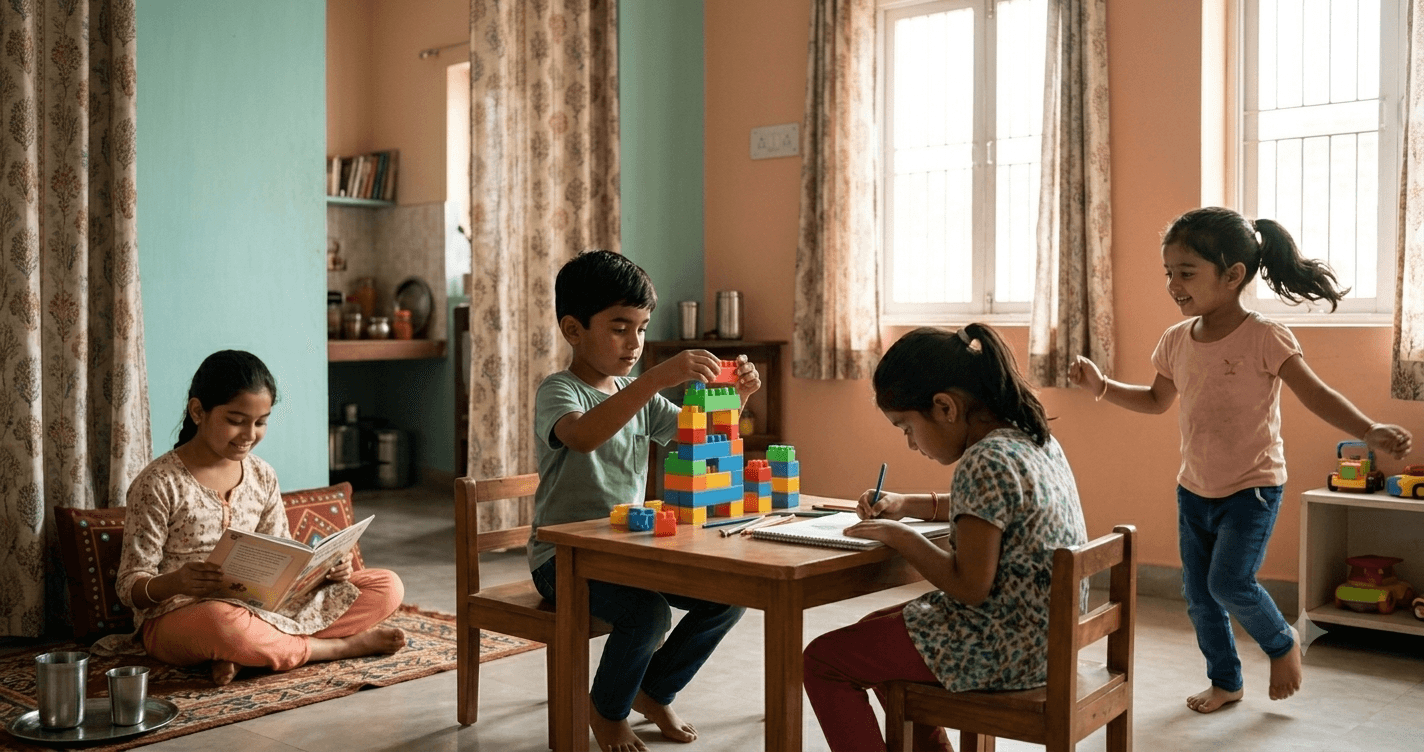
So consider what that means for a real child. A girl with extraordinary interpersonal intelligence — the one who resolves every fight in the friend group and reads adults like a book — gets no marks for it. A boy with deep spatial intelligence, who can picture and build complex structures in his head, sees none of that on a maths paper. A child wired for music, movement, or the natural world can sit in class looking entirely average, because the six intelligences they might be brilliant at are simply never tested.
The report card isn't lying. It's just looking through a narrow window at a very large room.
A fair word about the theory
It would be dishonest to present this as settled science. Gardner's framework has its critics, who argue that what he calls separate "intelligences" might be more accurately described as talents and abilities, and that the theory lacks the kind of hard empirical proof a lab scientist would demand.
That debate is real, and worth knowing about. But here's why it doesn't much change things for you as a parent: you don't need to settle an academic argument to act on the core, common-sense truth underneath it. Children are capable in more than one way. Marks capture a slice. The slice is not the child.
What this changes for how you raise your child
The practical shift is gentle but large. Instead of asking "how smart is my child?" — a question with one anxious answer — you start asking "in which ways is my child smart?" — a question with eight possible doors.
It changes what you praise. It changes which struggles you treat as failures versus simply mismatches. It changes whether an "average" report card sends you into worry or simply tells you this child's gifts live somewhere this test can't see.
And it changes the question of where to invest your time, energy, and money — toward the intelligences your child actually carries, rather than only the two the system happens to measure.
Seeing the fuller picture
The catch, of course, is that the other six intelligences don't come with a convenient score. That's exactly why a structured assessment can help — it looks across multiple intelligence zones at once, including the ones school never tests.
Our Talent Discovery assessment maps your child's strengths across five intelligence zones in about 30 minutes, for ₹99. It won't reduce your child to a number — that's rather the whole point. It gives you a wider, fairer picture than any single percentage ever could, and a clear starting point for nurturing the gifts the report card couldn't see.
Your child has always been smart in more than one way. The only thing that's been missing is a way to see all of it.
Sources: Gardner's theory of multiple intelligences, Northern Illinois University; Multiple intelligences overview, SimplyPsychology; Multiple Intelligences, Thomas Armstrong.